
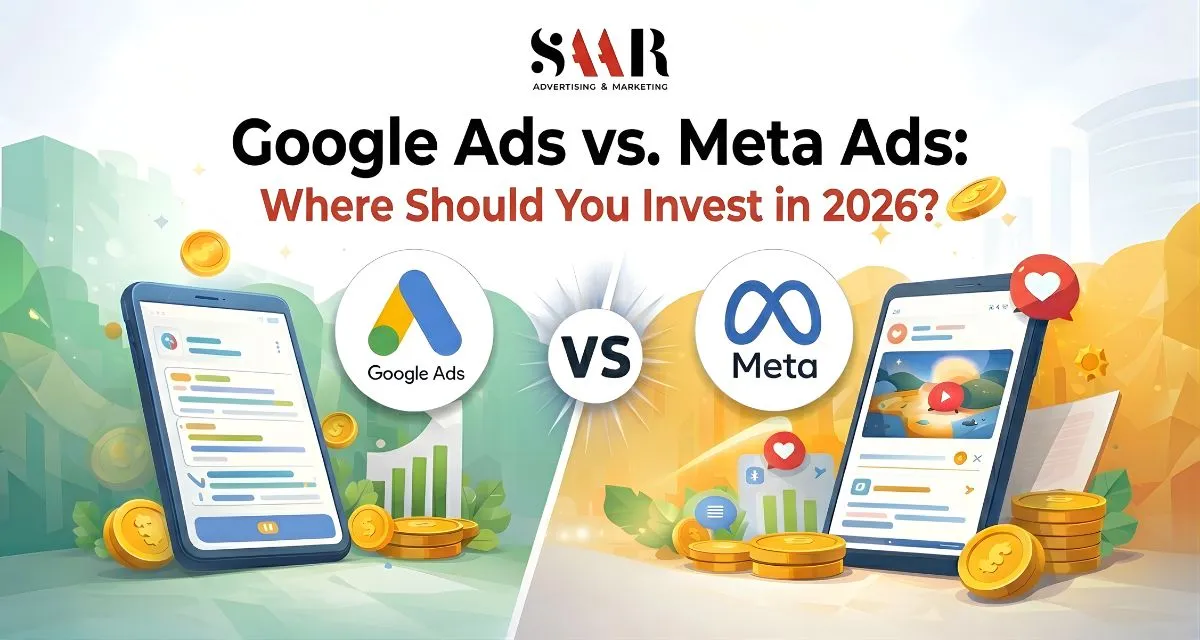
Google Ads vs Meta Ads: Where Should You Invest in 2026?
Published on: April 21, 2026
If you’ve run ads in the past couple of years, you already know this isn’t a simple “pick one and go” decision anymore. Costs are up, tracking is messier, and both platforms have doubled down on automation—sometimes helpfully, sometimes… not so much.
In 2026, choosing between Google Ads vs Meta Ads isn’t just about budget allocation. It’s about intent vs discovery, control vs automation, and how well you understand your own customer journey.
Let’s break it down in a way that actually helps you decide where your money should go.
Why This Decision Feels Harder in 2026
A few things have shifted:
- Privacy changes stuck: Signal loss from iOS and cookie restrictions haven’t gone away. Both platforms rely more on modeled data and AI.
- Automation is everywhere: Performance Max, Advantage+ campaigns—great when they work, frustrating when they don’t.
- Competition is brutal: More brands are bidding on the same audiences, which means higher CPMs and CPCs.
- Creative matters more than ever (especially on Meta): Bad creative = wasted spend, no matter how good your targeting is.
So now the question isn’t “which platform is better?”
It’s: which one aligns with how your customers actually buy?
The Core Difference: Intent vs Discovery
When you break down Google Ads vs Meta Ads, the core difference comes down to intent versus discovery.
- Google Ads = Capturing demand
- Meta Ads = Creating demand
If someone searches “best CRM software for small business”, they’re already halfway to buying. Google lets you intercept that intent.
If someone’s scrolling Instagram and sees your ad for a CRM? You’re interrupting, not responding. That’s a completely different game.
Both are powerful. But they solve different problems.
Audience Reach & Behavior
Google Ads
Google reaches people across:
- Search
- YouTube
- Display network
- Shopping
But the real strength lies in search behaviour. You’re targeting what people do, not who they are.
Best for:
- High-intent queries
- Problem-aware users
- Urgent needs (think “plumber near me” or “buy running shoes online”)
Meta Ads (Facebook + Instagram)
Meta thrives on:
- Passive browsing
- Interest-based discovery
- Visual storytelling
You’re targeting users based on:
- Interests
- Behaviors
- Engagement patterns
Best for:
- Lifestyle products
- Brand building
- Impulse-driven purchases
Real-world observation:
Meta can feel like shouting into a crowd unless your creative hits. But when it does, it scales fast.
Targeting Precision (and How It’s Changed)
- Keyword targeting is still king
- Strong contextual intent
- Audience layering (remarketing, in-market audiences)
But automation (like Performance Max) has reduced transparency. Sometimes you’re thinking: “Where exactly is my budget going?”
Meta
- Interest targeting has weakened over time
- Lookalike audiences still work—but need strong data
- Algorithm now relies heavily on creative + conversion signals
What this means in 2026:
- On Google, intent is your targeting
- On Meta, your creative is your targeting
That’s a big mindset shift.
Cost Efficiency (Where Your Budget Goes Further)
This is where things get nuanced.
Google Ads Costs
- Higher CPCs, especially in competitive industries
- But stronger conversion intent often offsets cost
Example:
- ₹200 per click might sound expensive
- But if that click converts at 8–10%, it’s worth it
Meta Ads Costs
- Lower CPCs and CPMs (usually)
- But weaker intent means lower conversion rates
Example:
- ₹20 per click sounds great
- But if the conversion rate is 1%, your cost per acquisition might actually be higher
Hard truth:
Cheap traffic isn’t always efficient traffic.
Learning Curve & Campaign Management
Google Ads
- Steeper learning curve
- Requires understanding:
- Keywords
- Match types
- Bidding strategies
- More technical
But once dialed in, it’s predictable.
Meta Ads
- Easier to launch
- Harder to master
Because:
- Performance depends heavily on creativity
- Results can fluctuate wildly
- Scaling isn’t always linear
If you’ve ever increased the budget and watched performance tank overnight, you’re not alone.
ROI Tracking (The Messy Reality)
- Stronger attribution (especially for search)
- Clearer conversion paths
- Still affected by privacy changes, but less than Meta
Meta
- Attribution is… let’s say “interpretive”
- Platform often over-credits itself
- Requires external validation (GA4, CRM data, etc.)
Experienced marketer insight:
Never trust Meta’s reported ROAS blindly. Use it directionally, not as gospel.
Best Use Cases: When Each Platform Wins
Choose Google Ads if:
- You sell something people actively search for
- Your product solves a clear, immediate problem
- You want consistent, intent-driven leads
Examples:
- SaaS tools
- Local services
- B2B solutions
- High-ticket products with research cycles
Choose Meta Ads if:
- Your product benefits from visual storytelling
- You need to build awareness before demand exists
- You rely on impulse or emotional buying
Examples:
- D2C brands
- Fashion, beauty, fitness
- Lifestyle products
- New or unknown brands
Can You (and Should You) Use Both?
Short answer: Yes, if your budget allows.
Here’s how they complement each other:
- Meta generates awareness → users later search on Google
- Google captures high-intent users → Meta retargets and nurtures
This combo often works better than either platform alone.
Simple funnel approach:
- Use Meta for discovery and engagement
- Use Google to capture demand and conversions
- Retarget across both
A Practical Decision Framework
If you’re trying to decide where to start and want to figure which is the best advertising platform in 2026, ask yourself:
1. Are people already searching for what you sell?
- Yes → Start with Google
- No → Start with Meta
2. Do you have strong creative assets?
- Yes → Meta becomes more viable
- No → Google might be safer initially
3. What’s your budget?
- Small budget → Focus on one platform
- Larger budget → Test both strategically
4. How long is your sales cycle?
- Short → Meta can work well
- Long → Google + retargeting is stronger
A Real-World Insight Most Guides Miss
Here’s something you only learn after spending real money:
Your first platform usually isn’t your best platform, it’s your learning platform.
- Google teaches you what people actually want (via search queries)
- Meta teaches you what messaging resonates (via creative testing)
Smart advertisers use both not just for conversions but for insights.
So… Where Should You Invest in 2026?
If you want a straight answer:
- Start with Google Ads if you need reliable, intent-driven results
- Start with Meta Ads if you need to create demand and build awareness
But the real advantage comes when you stop treating this as a binary choice.
The best-performing accounts in 2026:
- Test constantly
- Use data across platforms
- Align campaigns with actual customer behavior—not platform hype
What You Can Do Next (Actionable Steps)
If you’re making a decision right now:
Audit your demand
- Use keyword tools to check search volume
Evaluate your creative strength
- If your ads don’t stop the scroll, Meta won’t work
Run small, controlled tests
- Don’t go all-in immediately
Track beyond platform dashboards
- Use GA4, CRM, or backend data
Optimize based on reality, not assumptions
At the end of the day, the whole Google Ads vs Meta Ads debate isn’t really about picking a winner… it’s about building a paid advertising strategy 2026 that aligns with how your customers actually think, search and buy.
Final thoughts
If you’d rather not navigate that learning curve alone, this is exactly where SAAR Asia comes in. We work closely with businesses to map out where their audience actually sits whether that’s high-intent search on Google or discovery-driven platforms like Meta and build a balanced ad strategy around it. From budget allocation and campaign setup to ongoing optimization and performance tracking, we focus on making sure every rupee is invested where it’s most likely to drive real results, not just clicks.